By: A Systemic Scleroderma (Autoimmune) Warrior
This is a brief sharing to raise awareness about autoimmune diseases. Autoimmune diseases refer to a group of chronic conditions in which the body’s immune system mistakenly attacks its own healthy cells and tissues, instead of fighting infections. This leads to inflammation, organ damage, extreme fatigue, and joint pain. In other words, the effects of autoimmune diseases manifest differently within the body, depending on the type of condition. To date, there are more than 80 identified types of autoimmune diseases.

Infographic: Autoimmune Diseases
1) Main Factors Contributing to Autoimmune Diseases:
The exact cause is still unknown, but it involves the body’s immune response against its own tissues.
- Genetics/Hereditary Factors: A family history of autoimmune diseases increases an individual’s risk of developing related conditions.
- Gender and Hormones: Approximately 75% of autoimmune diseases occur in women, suggesting that hormones such as estrogen play a significant role.
- Environmental Factors: Exposure to toxic chemicals (such as asbestos and mercury), ultraviolet (UV) radiation from sunlight, and unhealthy environments.
- Viral or Bacterial Infections: Certain infections can trigger the immune system to react abnormally.
- Lifestyle Factors: Smoking, an unbalanced diet, obesity, and chronic psychological stress.
2) What Are the Signs of Autoimmune Diseases?
Although there are many types of autoimmune diseases, most share common symptoms, such as:
- Fatigue
- Joint pain and inflammation
- Skin issues
- Abdominal pain and digestive problems
- Recurrent fever
- Swollen glands
- Skin rashes
- Difficulty concentrating
Diagnosis is often challenging and usually requires evaluation by a medical specialist (commonly a rheumatologist) to determine the exact type of disease.
3) Treatment
Autoimmune diseases generally cannot be completely cured, but they can be managed to reduce symptoms and inflammation. Treatment often includes:
- Immunosuppressive medications
- Medications to relieve symptoms (such as painkillers)
- Lifestyle changes (balanced diet, regular exercise, stress management)
4) Public Awareness
Public awareness of autoimmune diseases remains very low, particularly among lower socio-economic groups.
Although efforts have been made to increase awareness, many misconceptions and myths still exist, largely because these diseases are poorly understood.
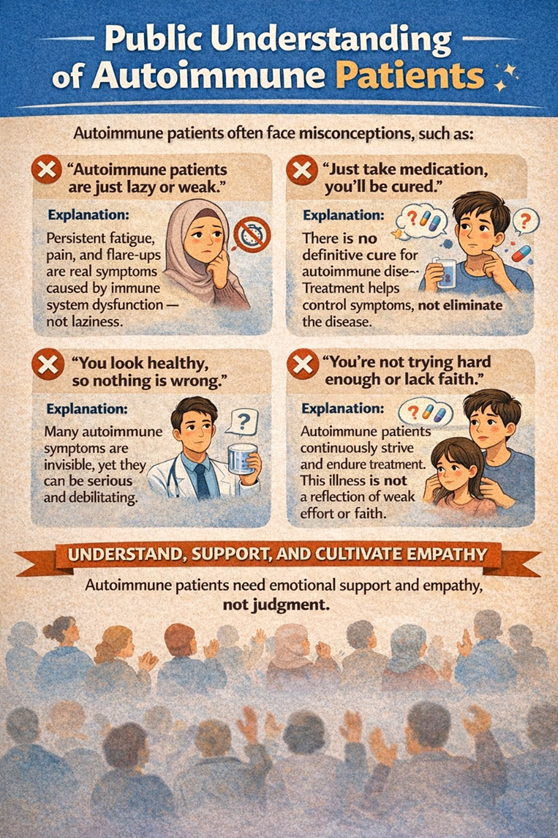
Infographic: Public Awareness
For someone who is newly diagnosed with an autoimmune disease, accepting the reality is not easy. Previously, life felt healthy and joyful, and daily activities could be carried out effortlessly. Then, without warning, an ordeal arrives—one that was never imagined in life’s journey.
It takes a long time to calm oneself, especially after hearing the doctor explain that there is no cure for this disease, only medications to control it so it does not continue attacking the body.
The hardest part for me is explaining this condition to others. From the outside, I appear healthy as usual, but the truth is, the pain exists within—silent, painful, yet real.
Tears bear witness, and solitude becomes a companion.
Until I finally learned one thing:
making peace with fate is not a sign of surrender,
but the first step toward strength.
Today, I choose to fight—
not as a victim of the disease,
but as a warrior who continues to endure.
Date of Input: 11/02/2026 | Updated: 12/02/2026 | nurulizzah
MEDIA SHARING











.jpg)