By: Dr. Maryam Adilah Zainal Arifin
Senior Lecturer
Faculty of Food Science and Technology, UPM
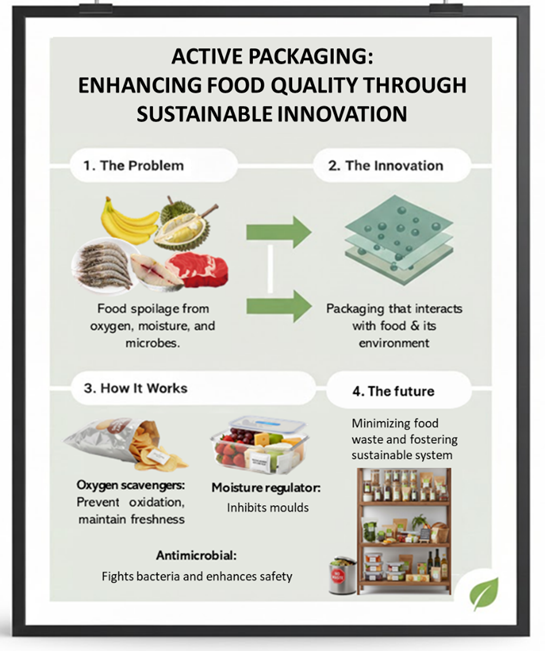
As biodegradable packaging technologies continue to evolve, researchers and manufacturers increasingly focus on systems that move beyond passive barrier functions. Active packaging represents the next stage of innovation by incorporating materials that interact directly with food or its surrounding environment to enhance quality and safety. Rather than merely containing food, active packaging responds to internal package conditions and extends product shelf life.
Active packaging systems integrate components that absorb, release, or regulate substances within the package. Oxygen scavengers, moisture absorbers, antimicrobial agents, and carbon dioxide emitters commonly serve this purpose. These components slow microbial growth, delay oxidative reactions, and preserve sensory attributes such as texture, flavour, and appearance. Active packaging offers a promising solution that balances functional performance with environmental sustainability when combined with biodegradable materials.
Recent research increasingly embeds active functions directly into biodegradable polymer matrices. Scientists use natural extracts, essential oils, enzymes, and bio-based nanoparticles as active agents because these materials interact effectively with biodegradable polymers. Manufacturers incorporate these substances into films or coatings to enable controlled interaction with food while maintaining material biodegradability. This approach supports the principles of sustainable material design and reduces reliance on synthetic additives.
The development of biodegradable active packaging supports key sustainability objectives, particularly Sustainable Development Goal 12 (Responsible Consumption and Production). Active packaging extends shelf life and maintains food quality, which helps reduce food losses and waste throughout the supply chain. This benefit becomes especially significant for perishable foods, where spoilage contributes substantially to global food waste. Active packaging therefore complements biodegradable materials by addressing packaging waste and food loss simultaneously.
The food sector increasingly adopts biodegradable active packaging across a wide range of applications. Fresh produce, meat, dairy, and bakery products benefit from active systems that regulate internal package conditions. Advances in material science and processing technologies continue to improve system stability, effectiveness, and scalability, which increases commercial viability.
Despite ongoing challenges related to cost, regulatory approval, and long-term performance, continued innovation drives rapid progress in this field. Active packaging marks a shift toward smarter and more responsive food packaging solutions that integrate environmental responsibility with effective food quality management.
Together, biodegradable and active packaging demonstrate how sustainability and innovation can converge in food packaging design. These systems combine environmentally responsible materials with enhanced functional performance and provide a pathway toward more efficient, resilient, and sustainable food packaging solutions for the future.
Date of Input: 03/02/2026 | Updated: 03/02/2026 | nurulizzah
MEDIA SHARING











.jpg)