The world’s population is growing rapidly and is projected to reach 10 billion people by 2050. Along with this, the demand for food, especially protein-based products, is expected to rise by 75% by 2050. However, with increasingly limited agricultural land and water resources, traditional farming methods are seen as incompatible with sustainability principles. For instance, the production of meat-based protein products generally contributes significantly to environmental degradation, including deforestation and greenhouse gas emissions, which exacerbate climate change. One progressive solution is to shift to alternative proteins that can offer superior nutrition and sustainability compared to conventional meat products.
Generally, there are three main drivers for replacing meat protein with more sustainable sources – plant-based proteins, insect proteins, and cultured meat. Entomophagy, or the consumption of insects as food, is one practice that is gaining global attention. The rationale behind entomophagy is due to the scarcity of arable land. This practice is more common in tropical regions, in line with the rich insect biodiversity that is more dynamic and easily accessible. Additionally, the rich biodiversity in our country, especially in Sabah and Sarawak, allows for the discovery of new insect species relevant to this entomophagy practice. More than 50 species of edible insects can be found in Sabah, Malaysia, including bee larvae, grasshoppers, and sago worms. Insects are typically roasted as it is easy, especially in remote areas. Although entomophagy is not commonly practiced, these insects are often consumed by the Kadazandusun, Murut, Bajau, and other ethnic communities during their childhood.
Insects are a highly nutritious alternative protein compared to traditional meat sources. They contain high levels of protein (35-61%), lipids (13-33%), as well as essential vitamins and minerals. Insect protein is highly digestible (76-98%), making it a valuable source in the diet. Furthermore, insects require less land and resources to farm compared to conventional livestock, making them an environmentally friendly option. For example, insects emit far fewer greenhouse gases and ammonia and have high feed conversion efficiency—twice as much as chicken and pigs and more than five times that of cattle. Producing 1 kg of insect protein, such as from grasshoppers, requires only six times the land, 2000 times less water, and 100 times fewer greenhouse gases compared to cattle farming.
Therefore, overall, insects are among the best alternative proteins for addressing food security due to their high nutritional value. However, external factors such as the repulsive appearance of insects, especially for those with insect phobias, remain one of the biggest challenges in the utilization of this protein source. The solution? – processing into derivative products such as flour, before being incorporated into staple foods like bread, cakes, and so on.
One of the most popular edible insects from a halal perspective is the grasshopper. Grasshoppers are herbivores from the order Orthoptera, and they hold potential as a protein food source. Islamic teachings permit the consumption of grasshoppers, with various authentic hadiths supporting this practice. For example, one hadith states, "Two types of carrion are permissible for us: fish and grasshoppers" (Sunan Ibn Majah 3218). Another hadith mentions that the Prophet and his companions ate grasshoppers during a military campaign (Sahih Muslim 1952, Sunan Abi Dawud 4357, Sunan al-Nasa'ie 4357). According to the Maktabah Al-Bakri website by former Minister of Religious Affairs, Dr. Zulkifli Mohamad Al Bakri, he cites several Quranic verses and Hadiths that permit the consumption of grasshoppers as halal food.
However, opinions regarding the permissibility of consuming other insects besides grasshoppers vary among the four main Sunni schools of thought. As a result, only grasshoppers are commonly consumed among Muslim communities in countries such as Saudi Arabia, Yemen, and Kuwait. In fact, grasshopper eggs are considered a delicacy among the Arabs. In our country, dishes made from grasshoppers, such as grasshopper kerutuk, are becoming increasingly popular among exotic food enthusiasts and provide additional income to local communities.
In conclusion, insects offer a sustainable and nutritious alternative protein source and present a potential solution to the future food security challenges. However, further research is needed on the halal status of various other edible insects. This is crucial for tapping into the rapidly growing global halal food market, which was valued at US$1.4 trillion in 2017 and is expected to reach US$2.6 trillion by 2023.
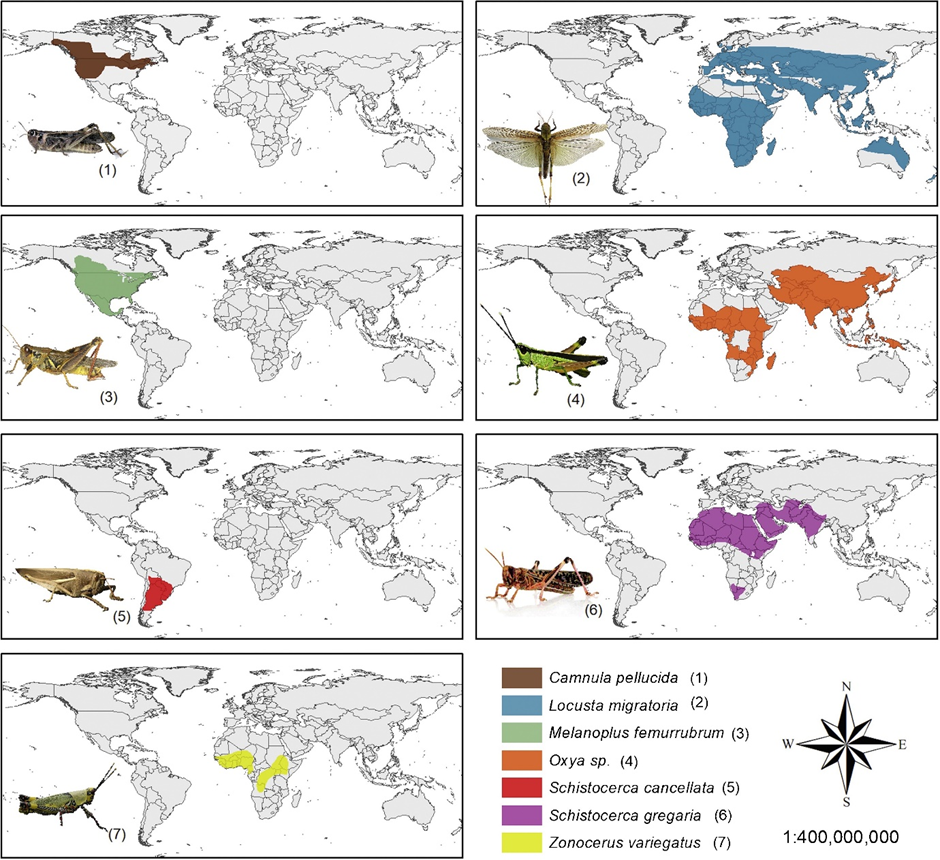
Figure: Distribution of grasshopper species worldwide. The distribution spans 16 countries, most of which are under the poverty line.
References
-
Suresh, Suganisha, Nurul Solehah Mohd Zaini, Muhamad Hafiz Abd Rahim, and Nurul Hawa Ahmad (2023). Insects and worms as an alternative protein source in the halal food industry. In Innovation of Food Products in Halal Supply Chain Worldwide, pp. 127-148. Academic Press, 2023.
-
Dr. Zulkifli Mohamad Al Bakri (2022). #524 Consuming Grasshoppers. MaktabahAlBakri. https://maktabahalbakri.com/524-memakan-belalang/
-
Torek Sulong. Grasshopper Kerutuk, A Special Dish for Aidiladha (2021). Kosmo. https://www.kosmo.com.my/2021/07/18/belalang-kerutuk-juadah-istimewa-aidiladha/
-
Japir, Razy & Fazrinah, Dg & Chung, Arthur. (2021). Insect Diversity in Sabah's Tropical Rainforest.
-
Chung, Arthur & Khen, Chey & Unchi, Sining & Binti, Momin. (2002). Edible Insects and Entomophagy in Sabah, Malaysia. Malayan Nature Journal. 56. 131-144.
Date of Input: 28/03/2025 | Updated: 30/06/2025 | nur_jasni
MEDIA SHARING











.jpg)