Prepared by: Dr Muhamad Hafiz Abd Rahim
Senior Lecturer,
Faculty of Food Science and Technology,
Universiti Putra Malaysia
Malaysia has long understood the value of research. For decades, public funding helped universities build expertise, train postgraduates, publish widely, and contribute to national development. The Fundamental Research Grant Scheme (FRGS) played a central role in that journey: it supported the kind of careful, methodical work that forms the bedrock of scientific progress.
But Malaysia’s higher education landscape is changing. And with it, the country’s expectations of publicly funded research.
Enter GET — Geran Eksploratori dan Transformatif, introduced under the Department of Higher Education (JPT). On paper, it is “just another grant”. In reality, it is a statement: Malaysia is no longer satisfied with research that is merely correct and publishable. It wants research that is bold, strategic, and capable of shifting systems.
A new philosophy: from understanding to transforming
GET distinguishes two broad intents: exploratory work that helps us understand unclear phenomena, and transformative work that aims to change policies, processes, or systems in a radical way.
The language matters. It signals a deliberate tilt away from incremental scholarship toward research that can generate a step-change in outcomes.
This is reflected clearly in how proposals are assessed. Beyond the usual research basics, GET places heavy weight on the project’s ability to catalyse significant impact — even “paradigm shifts” — and to align with national and global agendas.
In other words: good science is still required, but it is no longer enough.
The rise of Return on Value
One of the most notable shifts in GET is its emphasis on Return on Value (ROV). The grant calls on researchers to think beyond the project end-date and articulate what value is returned to the nation in exchange for investment — whether through intellectual property, talent development, or broader systemic change.
This is a cultural shift that many academics will feel immediately.
Under FRGS, research proposals often succeeded by presenting a strong gap analysis, sound methodology, and a publishable knowledge contribution. GET still demands rigor — but it adds a new question: What will Malaysia tangibly gain from this research?
New expectations: patents, risk, and partners
GET also introduces tighter, more “innovation-aware” requirements.
Applicants must now include quantifiable risk assessments and conduct a patent landscape search, even citing tools such as Lens.org as an example source.
That is not a small addition. It forces researchers to acknowledge that novelty exists within a competitive landscape — and that research should not reinvent what is already protected or well-known.
Collaboration is also no longer just a “nice-to-have”. It is formally weighted in evaluation, including partnerships that can adopt and apply outcomes at local, national, or international levels.
This aligns with a truth universities sometimes avoid: research rarely transforms society alone. It moves through networks — industry, agencies, communities, and institutions.
Funding that is focused — and constrained
GET’s ceiling is RM250,000 for two to three years, with strict limits on how many projects a researcher may lead across their service period.
This design makes the grant focused, disciplined, and competitive.
It also suggests that GET is meant to fund high-leverage ideas, not large research empires.
What GET replaces — and what it risks losing
It is tempting to frame this as a simple upgrade: FRGS was “old”, GET is “new”, therefore GET is “better”.
That would be unfair to FRGS.
FRGS helped build Malaysia’s research capacity across all fields, including those without clear patent pathways. It was a space where foundational research could mature — sometimes slowly — until it became the seedbed for future innovation. In many disciplines, that slow maturity is not a weakness. It is the point.
The risk with an impact-heavy model like GET is that researchers may start to over-promise, dressing normal incremental work in “transformative” language to stay competitive. Another risk is that areas with less obvious IP output may be disadvantaged if “patent-first thinking” becomes the norm, even when patents are not the most meaningful pathway.
Yet these risks are not reasons to reject GET. They are reasons to implement it wisely.
A healthier bargain between universities and the public
Ultimately, GET reflects a healthier bargain between universities and the public: if taxpayers invest in research, the system should be able to explain what value returns to society. That does not mean every project must produce a product. But it does mean projects should demonstrate relevance, strategic alignment, and a credible pathway to impact.
GET explicitly requires alignment with contemporary frameworks — including national aspirations and global agendas — and expects measurable objectives, robust methodology, and clear outcomes.
This is not “politicising research”. It is acknowledging that research funding is part of national development strategy.
The bottom line
FRGS built Malaysia’s academic backbone.
GET is trying to build Malaysia’s impact engine.
For researchers, the message is clear: the era of “publish and move on” is fading. Malaysia is asking its scholars to think bigger, plan more strategically, engage real partners, and show accountability for outcomes.
It is a harder standard.
But if executed well, it may be exactly the standard Malaysia needs.
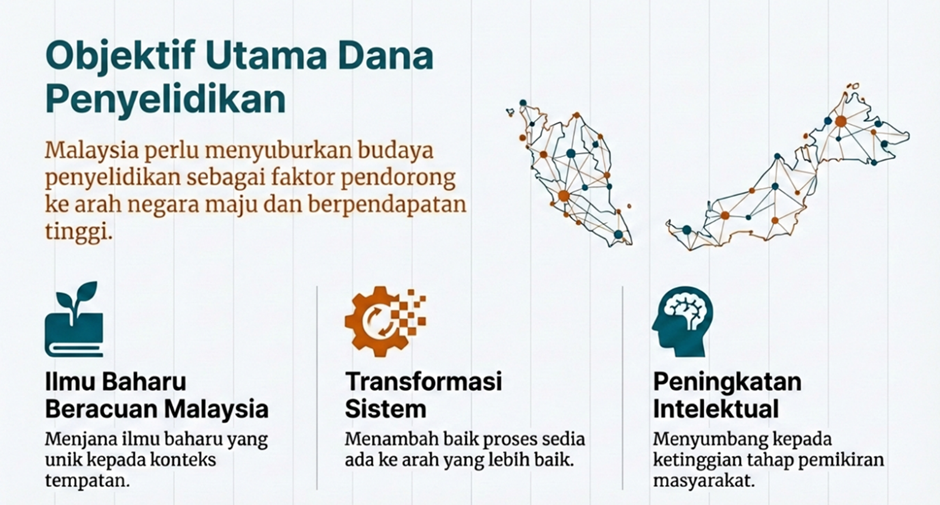
Figure. One of the primary aims of the research grant is to empower Malaysia through the generation of locally grounded new knowledge, systemic transformation for greater effectiveness, and the enhancement of societal intellectual capacity toward achieving developed and high-income nation status. Adapted from KPT Briefing Note, 2026.
Date of Input: 03/03/2026 | Updated: 03/03/2026 | nurulizzah
MEDIA SHARING










.jpg)