Prepared by:
Nur Syakirah Jasni (Executive Officer 4)
Office of the Deputy Dean (Development and Industry & Community Relations)
Faculty of Food Science and Technology
Universiti Putra Malaysia
A visit to Fukuoka, Japan, provides a profound perspective on sustainable development. Among the sites visited, The Kitakyushu Environment Museum stands out as a powerful testament to ecological resilience. As a member of the Faculty of Food Science and Technology (FSTM), I view this museum as far more than a historical archive; it serves as a definitive blueprint of how science, education, and human resolve can restore a shattered ecosystem.
A Dark History: A Warning for Industry and Science
In the 1960s, Kitakyushu was a heavy industrial hub suffering from critical pollution. Dokai Bay was notoriously labeled the "Sea of Death" as its toxicity levels reached a point where no marine life could survive. Furthermore, the skies were perpetually cloaked in "Seven-Colored Smoke” a visual manifestation of extreme air pollution resulting from unregulated industrial waste.
What is most inspiring, however, is how this recovery began. It did not start in a laboratory, but rather from a grassroots movement of local mothers who were deeply concerned about their children's health. Their courage in demanding change from industries eventually sparked an extraordinary synergy between the community, the government, and university research. For the FSTM community, this is a stark reminder that the food industry is also a significant contributor to organic waste and water consumption. Without sustainability-driven technology, we risk repeating such environmental tragedies.

Localizing the SDGs: Observations from the Streets of Kokura
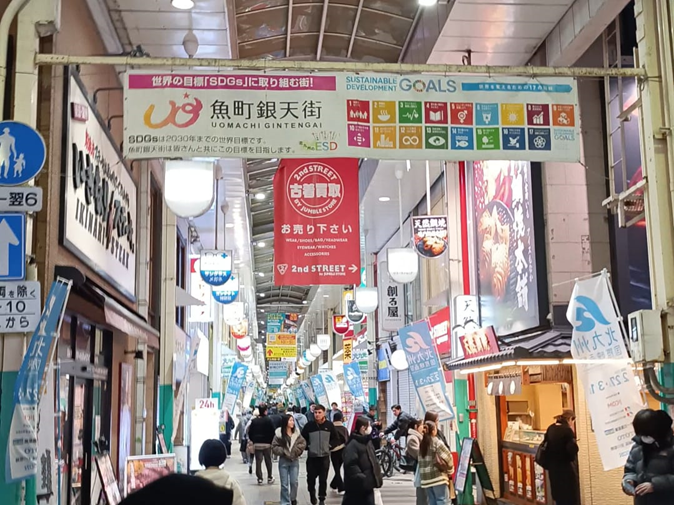
What is particularly striking while walking through the Kokura district is the visibility of the Sustainable Development Goals (SDGs) in everyday life. In bustling shopping alleys, large SDG banners are prominently displayed amidst local businesses. These are not merely corporate decorations; they represent a collective social commitment from the local community.
In Malaysia, the understanding of SDGs often remains confined to academic circles or annual reports, yet to be fully embraced by the public. In Japan, the SDGs have truly "hit the ground." This poses a critical question for the university community: To what extent have we successfully translated the language of SDGs so that they are understood and practiced by the general public?
The Strategic Role of FSTM and UPM
The observations in Fukuoka reinforce the conviction that the university must be a primary driver in addressing sustainability through several key goals:
- Quality Education (SDG 4): FSTM and UPM is responsible for ensuring that quality education goes beyond academic excellence to include character building. High-quality education produces an environmentally conscious society like the mothers of Kitakyushu who act as catalysts for change.
- Responsible Consumption and Production (SDG 12): Our focus on minimizing food waste through efficient processing technologies aligns perfectly with the sustainable practices observed in Japan.
- Zero Hunger & Food Security (SDG 2): The successful restoration of the marine ecosystem proves that a secure food supply is entirely dependent on environmental sustainability.
- Partnerships for the Goals (SDG 17): Transformative change only occurs when there is a robust network between university experts, industry players, and the community.
Conclusion
Advanced technology will not yield results without a fundamental mindset change rooted in holistic, quality education. The university cannot remain an "ivory tower"; it must bring the aspirations of the SDGs into the heart of society. A firm commitment is demanded to ensure that every innovation produced at FSTM today serves as a vital investment for the sustainability of future generations.
RUJUKAN / REFERENCES
- Kitakyushu Environment Museum. Official Portal: https://eco-museum.com
- City of Kitakyushu. Overcoming Pollution: The Kitakyushu Renaissance Story.
- JICA (Japan International Cooperation Agency). The Role of Citizens in Pollution Control: The Mothers of Kitakyushu.
- UNEP (United Nations Environment Programme). Case Study: Kitakyushu’s Transformation into a Green City.
Date of Input: 02/03/2026 | Updated: 02/03/2026 | nur_jasni
MEDIA SHARING











.jpg)